
Ever heard of Murphy’s Law? How about Parkinson’s Law or the Peter Principle?
These familiar workplace principles aren’t specific to maintenance and reliability, but they help explain some of the challenges maintenance teams face every day.
From jobs taking longer than expected to poor leadership decisions and unreliable performance metrics, these laws offer some surprisingly relevant lessons.
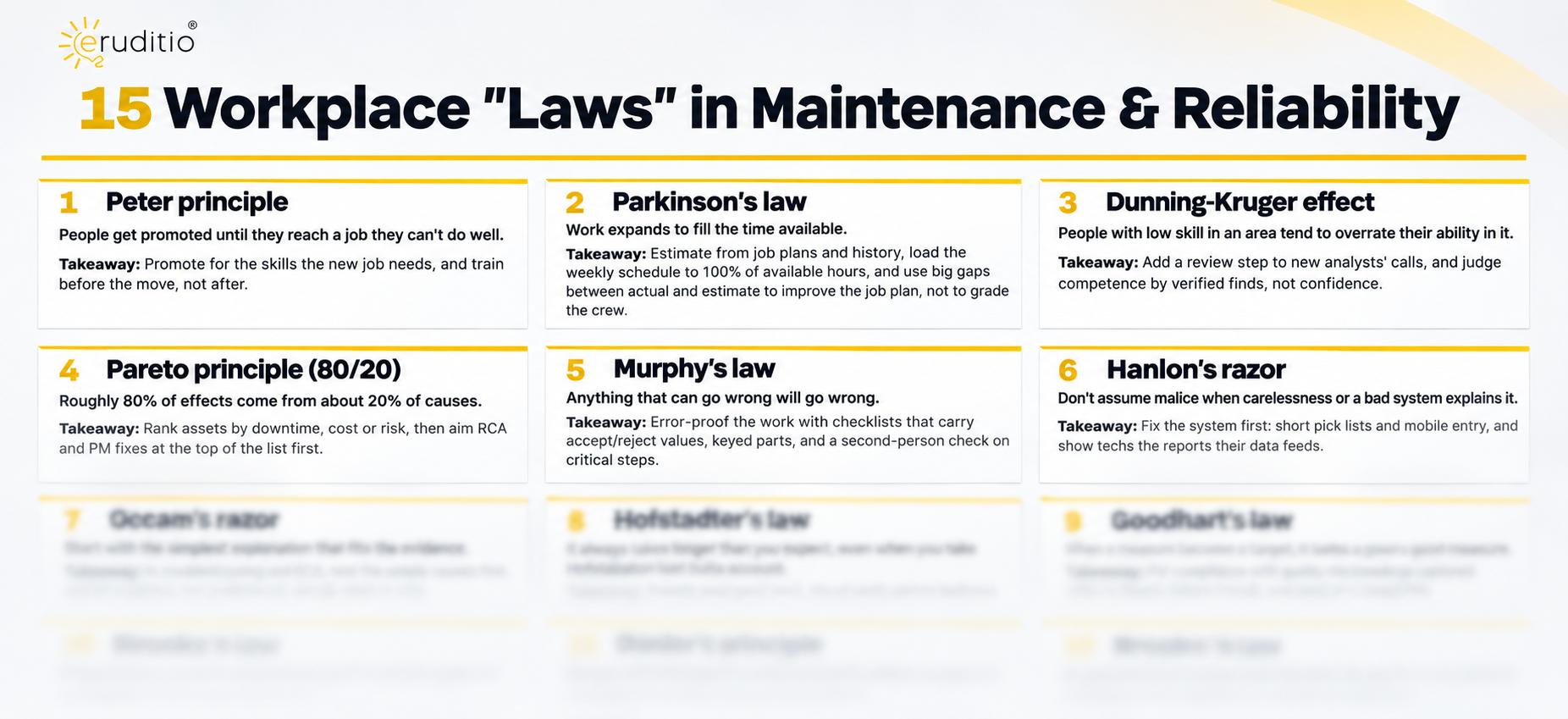
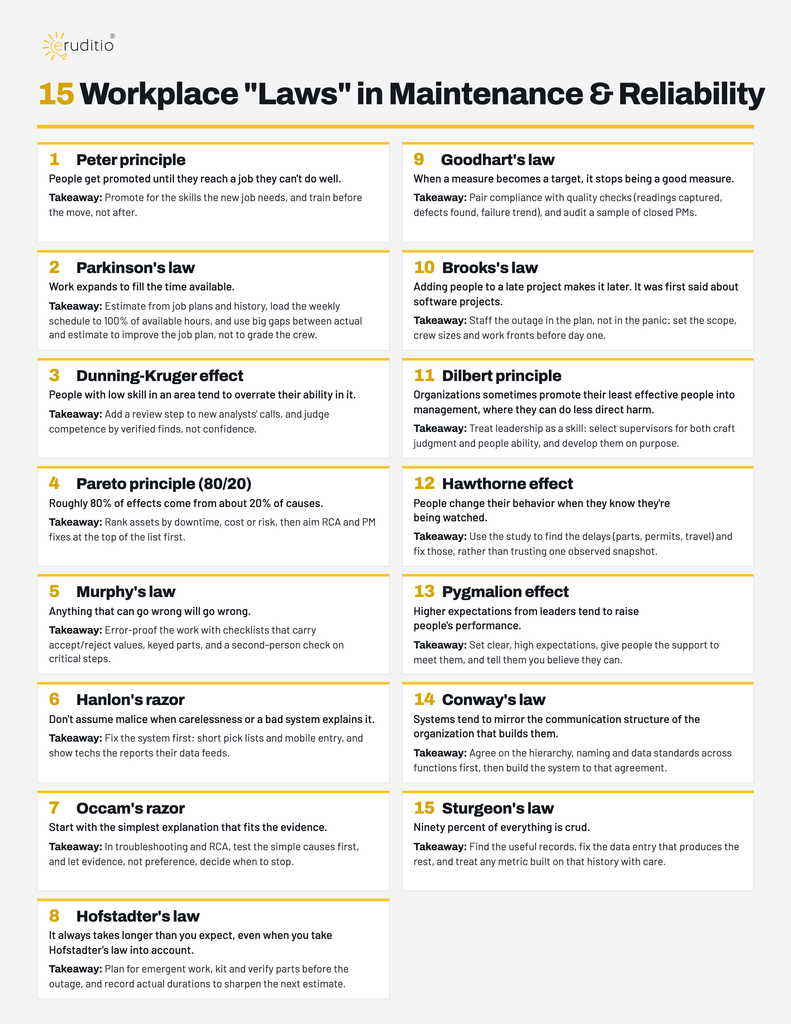
Here are 15 workplace laws and principles, what they mean, and how you can apply them to improve maintenance and reliability performance.
1. Peter Principle
The Law: People get promoted until they reach a job they can’t do well.
Maintenance & Reliability Takeaway: Being a great technician doesn’t automatically make someone a great maintenance supervisor. Promote based on the skills the new role requires, and provide leadership and management training before the transition, not after.
2. Parkinson’s Law
The Law: Work expands to fill the time available.
Maintenance & Reliability Takeaway: Without clear job plans and realistic time estimates, maintenance work can take longer than necessary. Use historical data to estimate job durations, schedule work to available labor capacity, and compare actual hours against estimates to improve future planning.
3. Dunning-Kruger Effect
The Principle: People with low skill in an area may overestimate their abilities.
Maintenance & Reliability Takeaway: Confidence isn’t the same as competence. Encourage peer reviews of failure analysis, verify troubleshooting conclusions with evidence, and invest in training that strengthens technical skills and decision-making.
4. Pareto Principle (80/20 Rule)
The Principle: Roughly 80% of effects come from about 20% of causes.
Maintenance & Reliability Takeaway: Not all equipment failures have the same impact. Identify the assets responsible for the greatest downtime, maintenance costs, or operational risk. Prioritize root cause analysis and preventive maintenance improvements where they can deliver the greatest return.
5. Murphy’s Law
The Law: Anything that can go wrong will go wrong.
Maintenance & Reliability Takeaway: Don’t leave critical maintenance activities to chance. Improve job plans with checklists, verify parts and tools before starting work, and build quality checks into critical maintenance tasks to reduce the risk of avoidable failures.
6. Hanlon’s Razor
The Principle: Don’t assume malice when carelessness or a flawed system could explain the problem.
Maintenance & Reliability Takeaway: When maintenance data is incomplete or work orders aren’t properly closed, the problem isn’t necessarily the technician. Look at the process first. Are forms too complicated? Are reporting expectations clear? Is the CMMS easy to use? Fixing the system may be more effective than blaming the people using it.
7. Occam’s Razor
The Principle: Start with the simplest explanation that fits the evidence.
Maintenance & Reliability Takeaway: Effective troubleshooting doesn’t always require a complicated explanation. Start with the most likely causes, test your assumptions, and use evidence to guide your investigation. Avoid jumping to complex conclusions before ruling out simpler possibilities.
8. Hofstadter’s Law
The Law: It always takes longer than you expect, even when you take Hofstadter’s Law into account.
Maintenance & Reliability Takeaway: Maintenance shutdowns and major repairs often involve unexpected complications. Account for potential delays, verify parts and resources in advance, and document actual job durations to improve future estimates and scheduling accuracy.
9. Goodhart’s Law
The Law: When a measure becomes a target, it stops being a good measure.
Maintenance & Reliability Takeaway: Focusing exclusively on a maintenance KPI can create unintended consequences. For example, pushing for higher preventive maintenance compliance may encourage teams to close work orders without ensuring the work was completed effectively. Balance compliance metrics with measures of work quality, defects identified, and equipment performance.
10. Brooks’s Law
The Law: Adding people to a late project can make it even later.
Maintenance & Reliability Takeaway: Throwing more technicians at an outage doesn’t always speed up recovery. Additional personnel require coordination, supervision, and clearly defined responsibilities. Establish the scope, crew sizes, and work assignments before work begins rather than adding resources in a panic.
11. Dilbert Principle
The Principle: Organizations sometimes promote their least effective employees into management, where they can do less direct harm.
Maintenance & Reliability Takeaway: Maintenance leadership shouldn’t be treated as a place to move employees who struggle in technical roles. Effective supervisors need sound technical judgment, communication skills, and the ability to lead people. Select leaders intentionally and invest in their development.
12. Hawthorne Effect
The Principle: People may change their behavior when they know they’re being observed.
Maintenance & Reliability Takeaway: A maintenance process may appear more efficient during a time study simply because employees know they’re being watched. Use observations to identify genuine workflow problems, such as delays caused by missing parts, permits, or travel, rather than assuming the observed performance represents normal conditions.
13. Pygmalion Effect
The Principle: Higher expectations from leaders can contribute to better employee performance.
Maintenance & Reliability Takeaway: Set clear, achievable performance expectations and give employees the tools, training, and support they need to succeed. When leaders demonstrate confidence in their teams and reinforce high standards, they can help build stronger performance and accountability.
14. Conway’s Law
The Law: Systems tend to mirror the communication structure of the organizations that build them.
Maintenance & Reliability Takeaway: When maintenance, operations, engineering, and other departments work in silos, the systems they develop can become fragmented too. Establish shared data standards, clear equipment hierarchies, and consistent communication processes before implementing or improving maintenance management systems.
15. Sturgeon’s Law
The Law: Ninety percent of everything is crud.
Maintenance & Reliability Takeaway: Maintenance records aren’t always reliable. Inconsistent failure codes, incomplete work orders, and inaccurate equipment histories can undermine analysis and decision-making. Focus on improving data quality at the source so your team can trust the information used to make reliability decisions.
Turn These Principles Into Better Maintenance & Reliability Performance
Recognizing these workplace laws is a useful starting point. But overcoming the challenges they describe requires more than awareness.
Effective maintenance and reliability programs depend on skilled people, well-designed processes, accurate information, and a proactive approach to continuous improvement.
At Eruditio, we help organizations strengthen these capabilities through practical maintenance and reliability training, including:
- Maintenance Planning & Scheduling: Improve job planning, resource coordination, scheduling efficiency, and work execution.
- Root Cause Analysis: Develop the skills to investigate equipment failures, identify underlying causes, and prevent recurring problems.
- Reliability Fundamentals: Build a stronger foundation in reliability principles, processes, and best practices.
- iBL® and iBL+ Training: Develop maintenance and reliability professionals through structured, role-specific learning programs.
Whether your team is struggling with reactive maintenance, inconsistent work execution, or skills gaps, the right training can help turn these everyday challenges into opportunities for measurable improvement.
Explore Eruditio’s Maintenance & Reliability Training Programs


